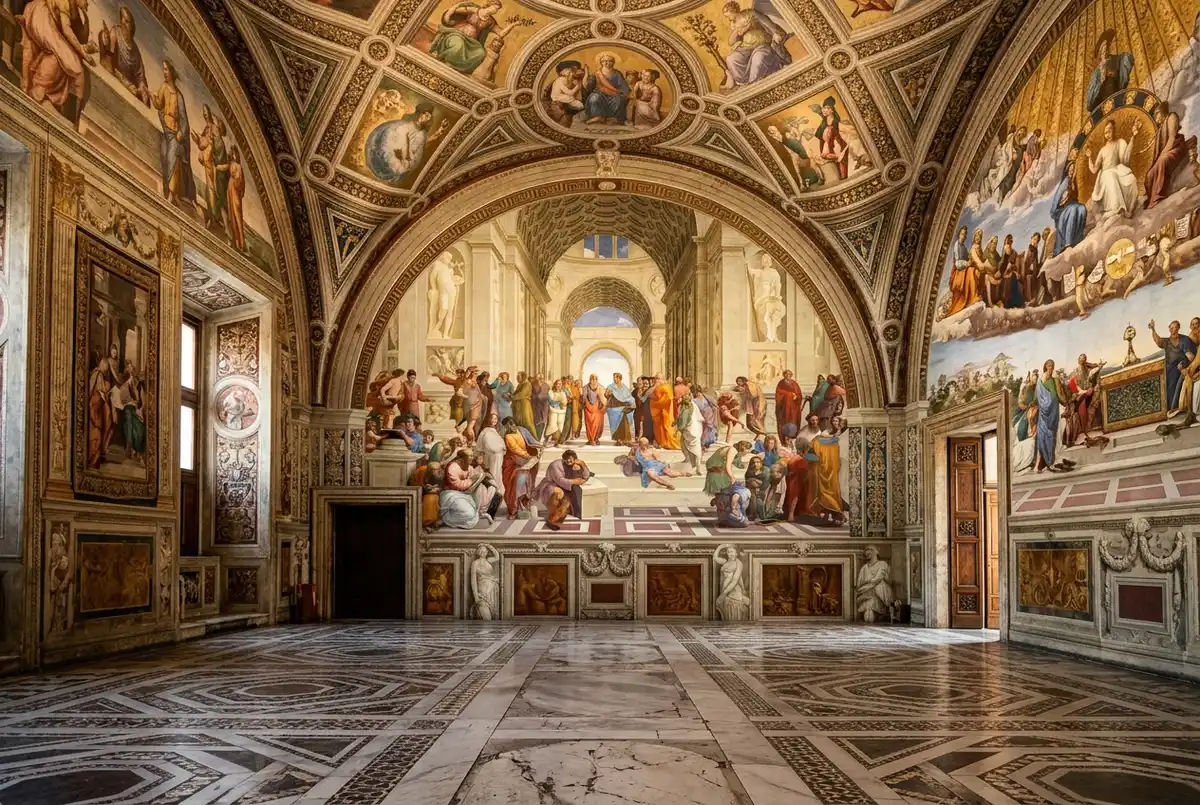
The Raphael Rooms, known in Italian as the Stanze di Raffaello, are four papal chambers that Raphael and his workshop frescoed between roughly 1508 and 1524, commissioned by Pope Julius II as his private apartments. Here’s what I’d actually do before you get there: don’t let the crowd flow rush you through, since these rooms sit directly on the path toward the Sistine Chapel and most visitors treat them as a hallway rather than a destination in their own right. If you’re still lining up the ticket side of your visit, every vatican pass ticket I currently track is listed on the homepage, and my what to see in the Vatican Museums highlights guide puts these rooms in context with the rest of the route.
What exactly are the Raphael Rooms?
Four connected chambers, the Stanza della Segnatura, Stanza di Eliodoro, Stanza dell’Incendio and Sala di Costantino, each frescoed with a different theme reflecting the papacy’s interests at the time, from philosophy and theology to political power and military victory. Raphael personally painted much of the first two rooms, while his workshop completed more of the later two after his death in 1520.
I’d point out that distinction specifically, since it explains why the quality and hand feel slightly different from room to room. The Stanza della Segnatura, home to the School of Athens, is widely considered the strongest of the four, and it’s the one I’d prioritize if your time is genuinely limited.
What is the School of Athens, and why is it so famous?
A fresco covering one wall of the Stanza della Segnatura, depicting dozens of classical Greek philosophers gathered inside a single imagined architectural space, with Plato and Aristotle at the center. Raphael is believed to have modeled several figures on contemporaries, including a figure resembling Michelangelo added partway through the project, likely after Raphael saw the Sistine Chapel ceiling still in progress.
My honest take: this detail is what makes the fresco genuinely interesting beyond its technical skill. It’s a snapshot of one Renaissance genius quietly acknowledging another, painted in the same building, at the same time, for the same patron. I’d point this figure out to anyone I was showing around, since it’s easy to miss without knowing to look.
Scholars generally identify Socrates, Pythagoras, Euclid, Ptolemy and several other classical thinkers scattered throughout the composition, though identification of some background figures remains debated among art historians. I wouldn’t worry about naming every single figure on a first visit; the composition works as a whole even before you know who’s who.
If you do want to go deeper, I’d focus on Plato and Aristotle at the very center first, since their gestures, Plato pointing upward and Aristotle gesturing outward, are widely read as representing idealism versus empiricism, the two poles the whole fresco is organized around.
Why do so many visitors walk past these rooms too quickly?
Because they sit directly on the route toward the Sistine Chapel, and the anticipation of reaching Michelangelo’s ceiling tends to pull visitors forward faster than the Raphael Rooms deserve. I’ve watched tour groups spend barely five minutes here before moving on, which genuinely undersells what’s on the walls.
I’d budget at least 15 to 20 minutes for the Stanza della Segnatura alone if the School of Athens interests you at all. It rewards a slower look more than almost any other single room on the standard route, precisely because it holds up under close attention rather than only working as a quick photo.
How does the Raphael Rooms rivalry with Michelangelo actually work?
Raphael and Michelangelo were both working for Pope Julius II at the same time, in neighboring parts of the same complex, and while accounts of an open rivalry are partly later legend, both artists were clearly aware of and influenced by what the other was doing. The figure resembling Michelangelo in the School of Athens is the clearest surviving evidence of that awareness.
I find this context genuinely adds to the visit rather than being trivia for its own sake. Standing in the Raphael Rooms and then walking a short distance to the Sistine Chapel, you’re tracing the physical path between two competing commissions that shaped how an entire era understood ambition in art.
What should you see in the other three rooms if you have time?
The Stanza di Eliodoro holds the Expulsion of Heliodorus and the Liberation of Saint Peter, the latter notable for its dramatic use of light. The Stanza dell’Incendio and the Sala di Costantino, completed mostly by Raphael’s workshop after his death, are less consistently praised but still worth a look if you’re not rushing.
I’d treat these three as genuinely optional if your time is tight. The Stanza della Segnatura is the one room I wouldn’t skip; the rest reward a visitor who already has a full morning to spend rather than someone protecting time for the Sistine Chapel ahead.
How does this connect to the rest of the Vatican Museums highlights?
The Raphael Rooms sit between the Gallery of Maps and the Sistine Chapel on the standard route, which means most visitors experience three of the museum’s biggest highlights back to back in under an hour. My Gallery of Maps guide covers what comes just before, and my Sistine Chapel ceiling guide covers what comes right after.
I’d read both if you want the fuller picture of that stretch of the visit, since the three stops build on each other more than most visitors realize while they’re walking through.
What I’d tell a first-time visitor
Don’t let the pull toward the Sistine Chapel rush you past the School of Athens. It’s a genuinely different kind of masterpiece, quieter and more intellectual than Michelangelo’s ceiling, and it deserves its own dedicated few minutes rather than a walk-through glance. For the fuller academic history of the Stanze, the Raphael Rooms entry at Wikipedia is a solid place to read further.
If I had to choose one thing to remember from this page, it’s this: find Plato and Aristotle at the center of the School of Athens first, then look for Michelangelo’s face among the philosophers. Once you know to look for it, you won’t be able to walk past this room quickly again.
Frequently asked questions
What is the most famous painting in the Raphael Rooms?
The School of Athens, located in the Stanza della Segnatura, depicting classical philosophers including Plato and Aristotle at the center. It’s widely considered Raphael’s masterpiece.
Did Raphael paint all four Raphael Rooms himself?
Not entirely. He personally painted much of the first two rooms, but his workshop completed more of the later two after his death in 1520, which is part of why quality varies slightly between rooms.
Is Michelangelo depicted in the School of Athens?
Many art historians believe a brooding figure added later to the foreground represents Michelangelo, likely added after Raphael saw the Sistine Chapel ceiling in progress.
How much time should you spend in the Raphael Rooms?
I’d budget at least 15 to 20 minutes for the Stanza della Segnatura alone, more if you want to see all four rooms without rushing.
Where are the Raphael Rooms on the Vatican Museums route?
They sit between the Gallery of Maps and the Sistine Chapel, near the end of the standard one-way route through the museum complex.