What to See in the Vatican Museums: Top Highlights
See prices From 32.5 EUR · Free cancellation available
Contents
Vatican museum highlights are easy to name and much harder to actually see well, because the Vatican Museums route runs through more than 50 galleries before it lets you out the other side. Here’s what I’d actually do if a friend asked me where to focus their energy: pick three stops and commit to them properly, rather than trying to absorb everything on one pass through a building this size. The Sistine Chapel ceiling, the Raphael Rooms and the Gallery of Maps cover the three most talked-about experiences in the collection, and conveniently, they also sit roughly in that order along the museum’s fixed, one-way path. Before I get into what makes each one worth the walk, it’s worth knowing what each of the eight Vatican Museums tours and tickets actually shows you room by room, since a guided option changes how much of this you’ll actually absorb compared with a self-paced ticket.
What’s actually worth seeing first in the Vatican Museums?
Nothing, technically, since the museum enforces one direction through its galleries and you can’t reorder the physical route even if you wanted to. What you can control is how much time you spend at each stop, and I’d weight that time toward the Sistine Chapel, the Raphael Rooms and the Gallery of Maps over almost everything else in the building.
That’s not a knock on the rest of the collection, which runs deep. The Pio Clementino’s classical sculpture and the Cortile del Belvedere are genuinely worth a look, and a determined visitor could spend an entire day here without getting bored. But if you’re the kind of person asking what to prioritize, I’d rather you protect your energy and your patience for the three stops that consistently earn their reputation, and move briskly through everything else on the way.
Check prices & dates
Ready to visit?
Book your tickets in advance: popular time slots sell out.
Why is the Sistine Chapel the highlight everyone talks about?
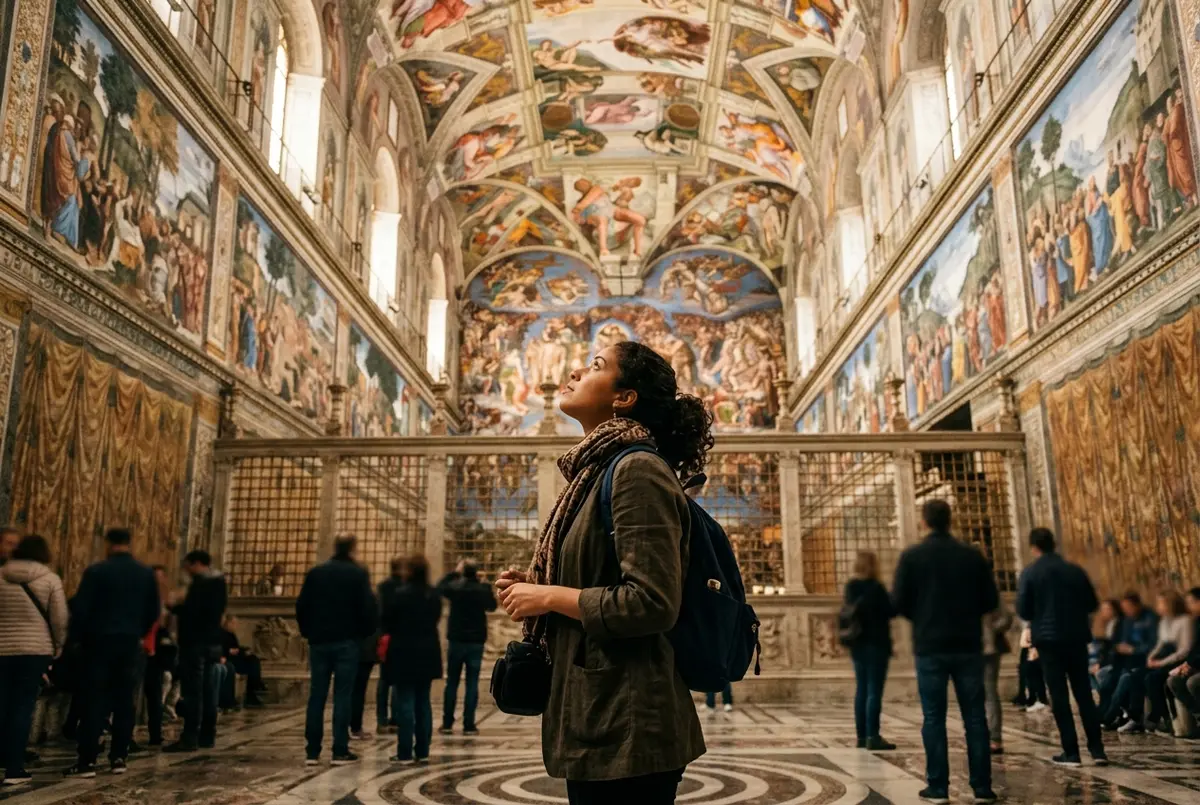
Because Michelangelo’s ceiling, painted between 1508 and 1512, remains one of the most technically and artistically demanding works ever completed by a single artist, and it still holds up under the weight of that reputation once you’re standing underneath it. The nine central Genesis panels, including the famous Creation of Adam, run the length of the chapel, with The Last Judgment covering the entire altar wall as a separate, later commission painted more than two decades afterward.
I’d tell any first-timer honestly: photos genuinely undersell it. No image conveys the scale of craning your neck upward at a ceiling painted with that much detail, held for that long, in a room that’s smaller than most visitors expect going in. My full breakdown of the Sistine Chapel ceiling goes panel by panel if you want the context before you go, which I genuinely think improves the visit more than almost anything else you could do to prepare.
What makes the Raphael Rooms worth the walk?
The School of Athens, mainly, a fresco covering one wall of the second Stanza that depicts dozens of classical philosophers gathered inside a single imagined architectural space. Raphael painted the four Stanze between roughly 1508 and 1524, working at the same time Michelangelo was on his scaffolding one wing over, and the quiet rivalry between the two commissions is part of what makes the rooms interesting beyond the art itself.
I’d budget more time here than most visitors do. The crowd flow tends to push people toward the Sistine Chapel fairly fast, and it’s genuinely easy to walk past the School of Athens without really looking at who’s depicted in it. My dedicated Raphael Rooms guide covers who’s standing where and why the room matters as much as the reputation suggests.
What is the Gallery of Maps, and why do people rush past it?
A 120 metre corridor lined with 40 painted topographical maps of Renaissance Italy, commissioned in the 1580s and startlingly accurate for their era, especially once you consider they were painted centuries before aerial surveying existed. Visitors tend to treat the corridor as a hallway to cross on the way to somewhere more famous, which I think is a genuine mistake given how much detail is packed into each individual panel.
I’d stop for at least 10 minutes here specifically, more if maps or Italian geography interest you at all. The gilded ceiling running the length of the corridor is worth looking up for on its own, and it’s one of the details I see visitors miss most consistently. My Gallery of Maps guide goes deeper into what each region actually depicts.
What else is worth stopping for along the way?
The Pio Clementino’s classical sculpture collection, especially the Laocoon group in the Cortile del Belvedere, a dramatic marble depicting a Trojan priest and his sons being attacked by sea serpents. I’d give this 20 to 30 minutes if classical sculpture interests you at all, since the collection here is genuinely one of the finest anywhere in the world, not just inside the Vatican.
The Gallery of Tapestries, hung with large Flemish-woven scenes, sits along the same general route and is easy to speed past without really looking closely at the weaving. I wouldn’t blame anyone for prioritizing the big three highlights over this one if time is genuinely tight, but if your trip allows a full morning, it’s worth slowing down for a few extra minutes.
Are the Vatican Gardens or the Necropolis part of these highlights?
No, and this trips up more first-time visitors than you’d expect. Both the Vatican Gardens and the Necropolis beneath St Peter’s Basilica require entirely separate, advance-booked tours that run apart from the standard Museums route, so neither shows up if you’re simply walking through on a regular ticket. I wouldn’t plan your day around either one unless you’ve specifically booked that add-on in advance.
If you’re weighing whether either is worth the extra planning, I’d treat them as a second-day option rather than something to squeeze into the same visit as the highlights above. Trying to cram all of it into one morning tends to leave visitors rushing the parts that actually matter most.
How should you order your visit to actually see all of this?
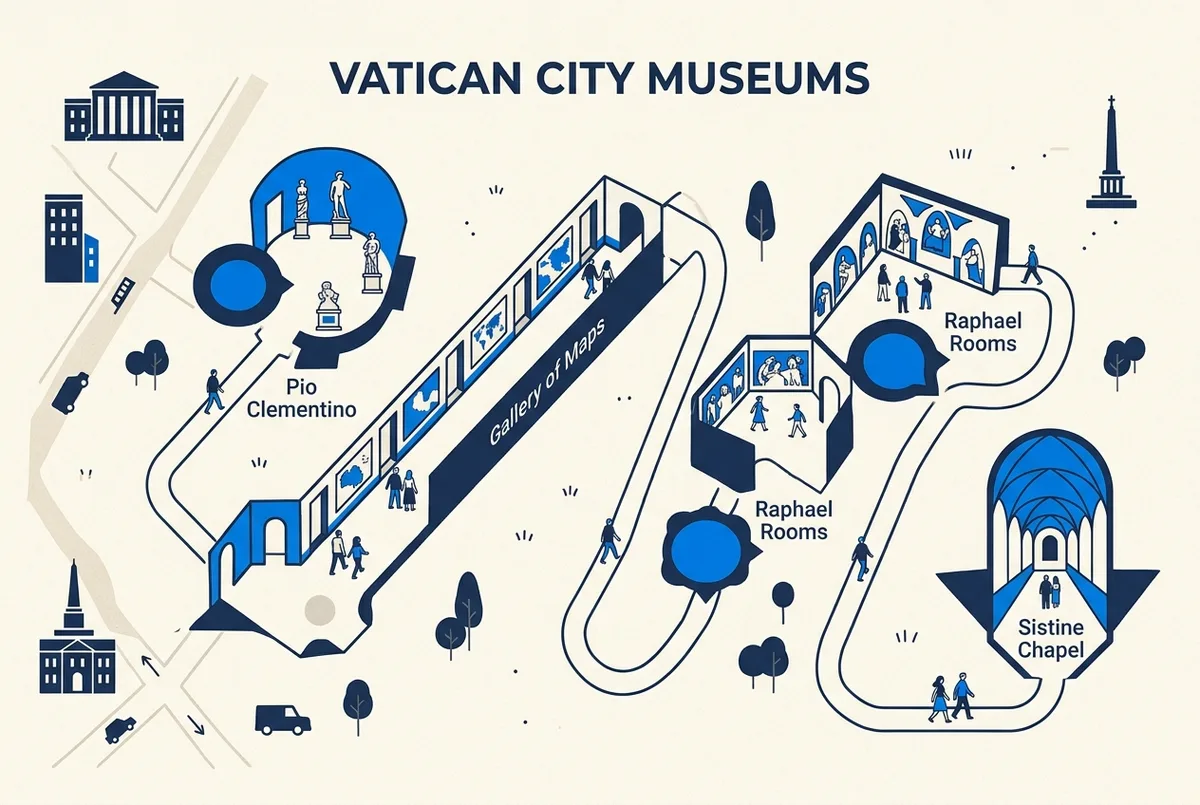
The museum’s fixed route already does most of the ordering for you: the Pio Clementino and the Cortile del Belvedere come first, then the Gallery of Tapestries and the Gallery of Maps, then the Raphael Rooms, with the Sistine Chapel as the final stop before the exit corridor. I wouldn’t fight this order even if I could, since it builds naturally toward the ceiling as the closing experience of the whole visit.
What you do control is pace, not sequence. I’d walk quickly through anything that isn’t on your personal shortlist, and slow down deliberately at your three or four priority stops, rather than giving every room equal time and running out of patience before you actually reach the Sistine Chapel at the end.
How much time should you budget for the highlights alone?
I’d budget at least two hours if you’re only hitting the big three: roughly 30 minutes for the Sistine Chapel, 20 for the Raphael Rooms, and 15 to 20 for the Gallery of Maps, plus walking time between them through a building this large. Add another hour on top of that if you want the Pio Clementino and the Cortile del Belvedere included too.
My honest take: rushing this whole list in under 90 minutes is technically possible but not enjoyable, and I’ve watched visitors do it and come out looking more exhausted than impressed. If your schedule is genuinely tight, I’d rather you cut the Gallery of Tapestries and the classical sculpture than shortchange the Sistine Chapel itself, since that’s the one stop most people actually came for.
Is it worth booking a guide just for these rooms?
If context matters to you as much as the visuals do, yes. A guide can point out who’s depicted in the School of Athens, or explain which Genesis panel you’re actually looking at overhead, in a way that a self-guided visit without prior research simply can’t match in the moment. I’ve found that a well-briefed guide roughly doubles what a first-time visitor genuinely takes away from these specific rooms compared with walking through cold.
If you’d rather read up beforehand and go at your own pace, that works too, and it’s the cheaper path by a wide margin. Either way, the content on this page and its linked guides should get you most of the way to a guide-level understanding of the big three highlights before you ever set foot inside.
What do first-time visitors usually miss?
The ceiling above the Gallery of Maps, oddly enough, since everyone’s eyes are locked on the painted wall panels instead. The Borgia Apartment, which sits along some tour routes just before the Sistine Chapel and holds its own set of genuinely significant frescoes. And actually stopping to look at The Last Judgment on the Sistine Chapel’s altar wall, since most visitors fixate entirely on the ceiling overhead and walk out without registering the second major fresco in that same room.
I’d flag all three specifically if you only remember one thing from this page beyond the big three highlights. They’re easy misses precisely because nothing about the museum’s layout forces you to notice them the way the main ceiling naturally does.
Does the order change if you’re on a guided tour instead of self-guided?
Not the physical route, since every visitor follows the same fixed path regardless of ticket type. What changes is the pacing: a guide typically times the walk so your group reaches the Sistine Chapel a little later, once the morning’s earliest crowds have thinned out slightly, and spends proportionally more time in the Raphael Rooms explaining the fresco than a self-guided visitor usually gives it.
I’d say this is one of the more underrated benefits of a guided format, separate from the narration itself. Someone else is managing your pace through the building, which for a first-time visitor overwhelmed by scale is genuinely worth something on its own.
What I’d actually prioritize
If I had to protect just three stops on a rushed visit, I’d pick the Sistine Chapel ceiling without hesitation, the Raphael Rooms for the School of Athens specifically, and the Gallery of Maps for how underrated it is relative to how little time most visitors actually give it. Everything else along the route is worth seeing if you have the time for it, but those three are the ones I’d build the whole visit around.
If your trip allows a full morning rather than a rushed hour or two, add the Pio Clementino and the Cortile del Belvedere without hesitation. The Laocoon group alone is worth the extra 20 minutes. For the practical side of actually getting in, my Vatican Museum tickets price guide covers what each ticket type costs and what it includes, and if you’d rather have someone explain these highlights to you in person, my guide to choosing the right Vatican tour format compares the guided options side by side. My Sistine Chapel tickets guide and St Peter’s Basilica tickets guide cover what comes right after the highlights above, since a lot of visitors treat all three as one connected morning. For deeper background on the collection itself, the Vatican Museums’ own history at Wikipedia is a solid starting point if you want to go further than this page does.
Frequently asked questions
What is the single most famous thing to see in the Vatican Museums?
Michelangelo’s Sistine Chapel ceiling, without much competition. It’s the reason most visitors book a ticket in the first place, and it sits at the very end of the standard museum route.
How long does it take to see the Vatican Museums highlights?
Budget at least two hours for the Sistine Chapel, Raphael Rooms and Gallery of Maps alone, and closer to three to four hours if you want the Pio Clementino and Cortile del Belvedere included too.
Can you skip straight to the Sistine Chapel without seeing the rest?
Not really, since the museum enforces a single fixed route and the Chapel sits near the very end of it. You’ll pass through most of the other galleries on the way whether you stop in them or not.
Is the Gallery of Maps worth stopping for?
Yes, genuinely more than most visitors expect. Forty painted panels of Renaissance Italy line a 120 metre corridor, and it’s one of the more overlooked highlights on the whole route.
Do you need a guide to appreciate the Vatican Museums highlights?
Not strictly, but a guide adds context that’s hard to replicate on your own in the moment, especially in the Raphael Rooms and the Sistine Chapel. A little pre-trip reading closes most of that gap if you’d rather go self-guided.