See prices From 32.5 EUR · Free cancellation available
Contents
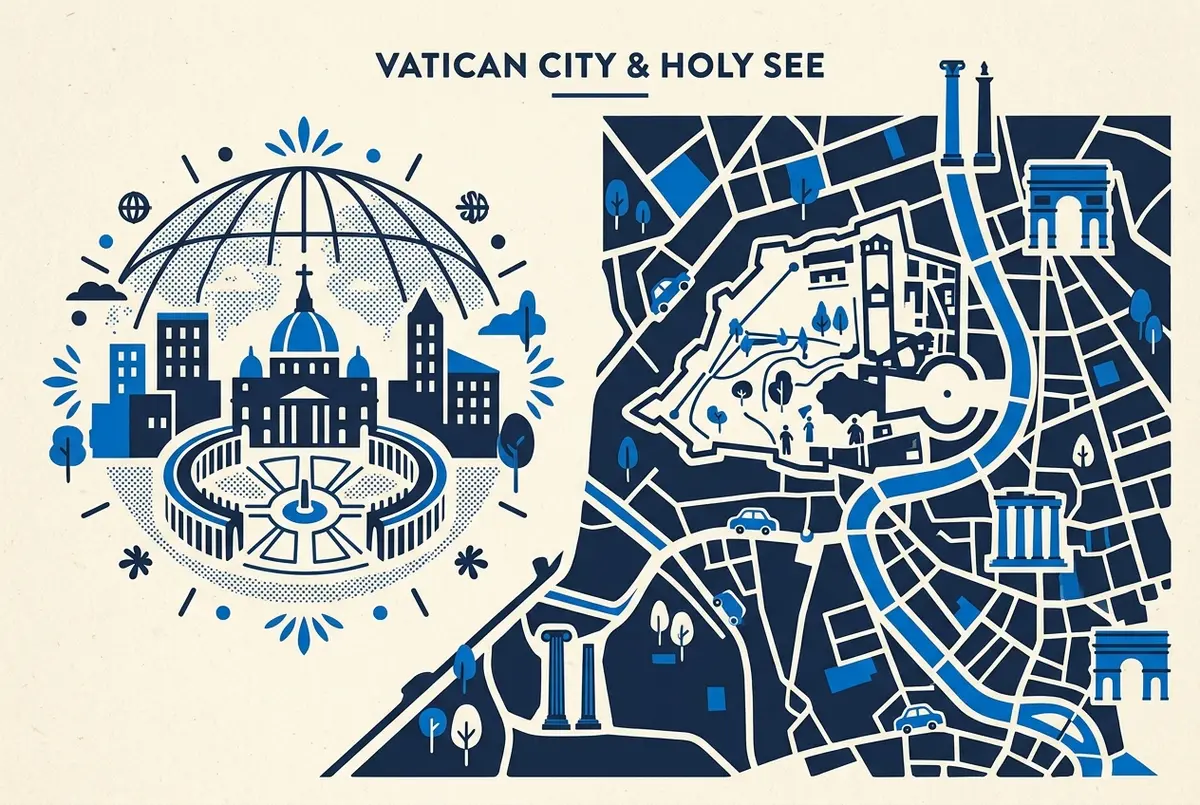
Vatican vs Vatican City comes down to institution versus territory. “The Vatican,” in everyday use, usually refers to the Holy See, the central governing authority of the Catholic Church. “Vatican City” is the specific, physically bounded sovereign state, the smallest country in the world, where that authority happens to be headquartered. Here’s what I’d say to untangle it fastest: the Holy See existed as a governing entity for centuries before Vatican City existed as a modern sovereign state, and separating those two ideas clears up nearly every other confusing fact people run into on this topic. If you’re weighing the passport and citizenship trivia that usually comes bundled with this question, my Vatican passport and citizenship facts pillar covers that in full, and the current vatican pass ticket lineup I keep updated is on the homepage whenever you’re ready to plan the actual visit.
What exactly is “the Vatican” referring to?
Most commonly, “the Vatican” is shorthand for the Holy See: the Pope, the Roman Curia, and the broader administrative and spiritual authority that governs the worldwide Catholic Church. It’s an institution, not a place, even though it’s almost always talked about as if it were one.
I think this is the single most useful reframe for anyone confused by this topic: stop picturing “the Vatican” as a place on a map at all. Picture it as an organization, the way you’d think of any other governing body, and the rest of this question gets a lot easier to follow.
Check prices & dates
Ready to visit?
Book your tickets in advance: popular time slots sell out.
Vatican City is the actual sovereign state: a walled enclave inside Rome, established as an independent country by the Lateran Treaty in 1929, with defined borders, its own government, and its own legal status under international law. It’s the physical, geographic answer to the institutional question above.
My honest take: I’d describe Vatican City as the “headquarters building” for the Holy See’s operations, if that headquarters happened to also be a fully sovereign country. That framing sounds almost too simple, but I’ve found it clarifies the relationship better than a more formal explanation usually does.
Does Vatican City have citizens the way other countries do?
Yes, but not in the way most countries assign citizenship. Vatican City citizenship is functional, tied to holding a specific role connected to the Holy See’s administration, rather than granted by birth within its borders or by residence over time. Cardinals residing there, Swiss Guards, and Vatican officials can hold it, generally for as long as that role continues.
I would not compare this to how citizenship works anywhere else you’ve likely lived or traveled. It’s genuinely one of a kind, and I think that’s exactly why it’s worth understanding rather than skimming past as a technicality.
So is the Pope the head of the Vatican or of Vatican City?
Both, and that dual role is actually a clean example of how these two ideas connect. The Pope leads the Holy See as the Church’s supreme spiritual and governing authority, and simultaneously serves as the head of state of Vatican City, the sovereign country. One person, two distinct roles that happen to overlap completely in this specific case.
I’d point to this as the clearest real-world proof that “the Vatican” and “Vatican City” aren’t simply two names for the same thing. If they were identical, there’d be no need to describe the Pope’s authority in two separate ways at all.
Why does this distinction actually matter for anything?
It matters most clearly in diplomacy and international law. The Holy See, as an institution, maintains diplomatic relations with the large majority of the world’s countries and holds a unique observer status at the United Nations, separate from Vatican City’s own status as a sovereign territory. Two related but legally distinct entities, each doing real work in the world.
I would not dismiss this as a technicality reserved for international law scholars. It’s the reason the Pope can conduct global diplomacy as head of the Holy See while Vatican City itself remains a tiny, largely ceremonial territorial state. Understanding the split explains a lot of what otherwise looks contradictory.
Does this affect anything about visiting as a tourist?
No, practically nothing. As a visitor, you’ll walk between Rome and Vatican City freely, with no border formalities, and every ticket, tour or mass request on this site treats “the Vatican” the way most people casually mean it, the general area and institution you’re visiting, without requiring you to keep the technical distinction straight.
I would not stress over getting this terminology exactly right while you’re actually planning your trip. It’s genuinely good to know, and it makes you sound sharp if it comes up in conversation, but it changes nothing about how you’ll book a ticket or walk through St Peter’s Square.
How does the passport question connect to this?
Directly, and it’s usually the moment this distinction actually clicks for people. Vatican passports are issued by Vatican City, the sovereign state, to individuals connected to the Holy See’s work, which is exactly why understanding the institution-versus-territory split makes the passport rules make sense instead of feeling arbitrary.
I’d send anyone who came to this page from a passport search straight to my page on Vatican passport strength and visa-free travel, since it builds directly on the distinction covered here. And if the Pope’s own travel is what brought you here, can the Pope leave Vatican City answers that specific question directly.
What I’d actually want you to remember
If you only take one thing from this page, take this: “the Vatican” is an institution, the Holy See, and “Vatican City” is the sovereign country it’s headquartered in. Nearly every other confusing fact about Vatican passports, citizenship, or the Pope’s dual role traces back to keeping these two ideas straight. I’d genuinely recommend holding onto that one-line distinction over memorizing any of the more detailed trivia elsewhere on this site, since it’s the key that unlocks the rest.
For the fuller citizenship and passport picture, my Vatican passport and citizenship facts pillar is the place to go next. For the official record on Vatican City as a sovereign state, the Vatican City entry at Wikipedia is a well-sourced place to read further if this topic genuinely interests you.
Frequently asked questions
Is “the Vatican” a country?
Not exactly. “The Vatican” most often refers to the Holy See, the Church’s governing authority. Vatican City is the specific sovereign country, the smallest in the world, where that authority is based.
Does Vatican City have its own citizens?
Yes, but citizenship is tied to holding a specific role connected to the Holy See’s administration, such as the Swiss Guard or senior clergy resident there, rather than being granted by birth or residence.
Is the Pope in charge of both the Vatican and Vatican City?
Yes. The Pope leads the Holy See as the Church’s supreme authority and simultaneously serves as head of state of Vatican City, the sovereign territory, as two connected but distinct roles.
Does this distinction matter for planning a visit?
Practically, no. You’ll move between Rome and Vatican City with no border formalities, and it doesn’t change how you book a ticket, a tour, or a mass request anywhere on this site.